Tuesday, 19 June 2012

BIO 12 UNIT 4: Study Notes

AUTONOMIC NERVOUS SYSTEM REGULATION

  • Involuntary Control of blood pressure and heart rate
    • BP too low ---> Response is CONSTRICTION of arterial walls (smooth muscle)
    • BP too high ---> Response is RELAXATION of arterial walls (smooth muscle)
  • 2 Subdivisions of Nervous System:
    • Sympathetic: Increases BP by increasing heart rate (Contraction: works when BP is too low, excitation, "fight or flight", unusual/dangerous situations)
    • Parasympathetic: Decreases BP (Inhibits Sympathetic system, prevents an increase in BP, decreases heart rate, relaxes, works when BP is too high, stabilizer)
HERE IS A HELPFUL VIDEO EXPLAINING THE CONCEPT:


BIO 12 UNIT 4: Study Notes

SA Node, AV Node, Purkinje Fibers

  • SA NODE= Found at upper portion of Right Atrium (wall), initiates the heart beat, sends out an "excitation" impulse every 0.85 sec to cause atrial contractions, keeps heartbeat regular (pacemaker)
  • AV NODE= Found in base of Right Atrium (near septum), signals ventricular contraction by sending signals to the pukinje fibers
  • PURKINJE FIBERS= Small and numerous, extending from two large fibers that carry the signal from the AV node through the ventricular walls, responsible for ventricular contractions occuring
VIDEO TIME... :)

Thursday, 14 June 2012

BIO 12 Fetal Pig Dissection Assignment

Observations: looks small, yellow, undeveloped, excess skin, feels moist, soft, toes are hard, smells like fermalphadide (stinky)
Female Pig indicated by flap located near the tail of the pig

DISCUSSION: It was a unique experience which I thoroughly enjoyed, it connected all of the big ideas of the course so far and was rich in learning opportunities. I was surprised by how small the pig was, how large the liver was, how delicate the pig was, how weird the stomach was, and how peculiar the brain was. What interested me was uncovering the various vital organs of the pig anatomy (ie locating the lungs, heart, gall bladder, etc.) This was a valuable learning experience because it for the first time visualized , the various body systems we have learned about this year in a central anatomy that we were face to face with (more meaningful than a textbook diagram). The pig showed the interconnectedness of the body systems (the digestive and excretory system, rectum, intestine, anus, the respiratory system and circulatory system, the heart, lungs, etc.)

Saturday, 26 May 2012

BIO 12 UNIT 3: Study Notes

IMPORTANCE OF PH IN DIGESTIVE TRACT

  • Enzymes will denature if they are not at the right pH
  • Stomach pH must be acidic to kill bacteria (HCl) and for certain enzymes to activate such as PEPSIN from pepsinogen (pH 2) [breakdown of carbohydrates]
  • Salivary Glands in the mouth must maintain a neutral pH for mechanical/chemical digestion to occur
  • Small Intestine: pH variations to match specific digestive enzyme conditions (pancreas: sodium bicarbonate) [neutralizes acidic environment]

BIO 12 UNIT 3: Study Notes

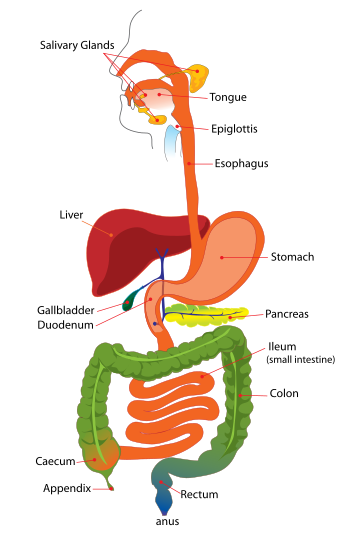
Structure and Function of Digestive System Parts


  • Mouth--> Beginning of digestive tract (where food first enters), site where chewing and initial breakdown occurs in order for food to pass through digestive tract
  • Tongue--> Causes initial food break down by moistening food to make it easier to pass through digestive tract; taste buds send nerve impulses to the brain
  • Teeth--> Chews large food particle into smaller more manageable chunks that can easily move down the digestive tract [sharp] (mechanical/physical digestion)
  • Salivary Glands--> Lubricates food, produces saliva (salivary amylase); solid with millions of secretory cells, tiny ducts that collect saliva into one centralized duct which carries saliva from gland to mouth
  • Pharynx--> Back of throat where food and air particles travel through to get to the throat (passageway)
  • Epiglottis--> Thin flap of elastic cartilage located in throat, prevents food and drink from falling down the airway (safe digestion) [prevents choking and drink from  going to the wrong bodily system]
  • Esophagus--> Located in throat close to trachea, food receptor when swallowing occurs with the aid of muscular contractions called peristalsis the food is delivered to the stomach through your esophagus; muscular tube
  • Cardiac Sphincter--> Between stomach and esophagus, prevents heartburn  (does not allow food/acid to pass back up the trachea--> pushes down to stomach)
  • Stomach--> Holding container food while it is mixed with various enzymes that further break down the food into a usable energy form, mucus protects stomach from its own acidic lining and enzymes that are responsible for chemical breakdown process, once contents are sufficiently dealt with they travel to the small intestine
  • Pyloric Sphincter--> Between small intestine and stomach, smooth muscle, allows food [chyme] to enter the small intestine (duodenum)
  • Duodenum--> The first 25 cm of small intestine where digestion of food occurs (starts at pyloric sphincter and extends towards the middle of the small intestine)
  • Liver--> Processes nutrients absorbed from small intestine, secretes bile into small intestine to aid in digestion of fat, "chemical factory"; takes in all raw materials absorbed from intestine and produces various chemicals for body functionality, breaks down and secretes drugs
  • Gall Bladder--> Stores and concentrates bile, releases to duodenum to aid with absorption and digestion of fats
  • Pancreas--> Secretes digestive enzymes into duodenum that aid in fat, carbohydrate, and protein breakdown; makes and secretes insulin (key hormone in sugar metabolism)
  • Small Intestine--> 22 foot long muscular tube, breaks down food with pancreas released enzymes and bile; peristalsis occurs here, food movement and mixture with digestive secretions from pancreas and liver; duodenum responsible for much of break down/digestion of food while the rest of the small intestine absorbs nutrients into the bloodstream; turns food semi-liquid to liquid (water, bile, mucous changes consistency --> nutrients absorb, left-over food residue liquid passes through intestine and eventually to colon)
  • Appendix--> Four inch long tube that is connected off near the small and large intestine (lower right abdomen); unknown function (scientists assume that it stores good bacteria to replenish the body after diarrheal illness or that it serves no purpose at all [evolution])
  • Large Intestine (Colon)--> 6 foot long muscular tube connecting small intestine to rectum, waste processing organ waste from digestion passes to the colon via peristalsis in liquid form, water is detracted and it is stored and released once or twice a day; stool is composed of food debris and advantageous bacteria, when colon is full of feces it empties contents into rectum to allow for elimination
  • Rectum--> 8 inch chamber connecting the colon to the anus, receives waste from the colon and stores it until it is released (evacuation); when something enters the rectum brain sensors determine whether contents should be released or not; if so, sphincters relax and contract and if not than the sphincter contracts and the feeling is eventually subsided
  • Anus--> Final element of digestive tract, 2 inch long canal composed of pelvic floor muscles and two anal sphincters, lining determines if contents are liquid, solid, or gas; sphincter muscles prevent stool from exiting at an inopportune time and pelvic floor stops stool from coming out when it should not; internal sphincter remains tight not allowing stool through (we are not aware of presence of stool) and external sphincter holds wastes inside until we go to the toilet during an urge to get rid of wastes

BIO 12 UNIT 3: Study Notes

Sequence of Events in Ovarian Cycle

1) Follicular phase: Follicle develops due to FSH released from the pituitary gland, this results in the the follicle producing estrogen and progesterone

2) Ovulation: occurs in midway of cycle (day 14), egg is released into the oviduct due to a surge in LH levels from the pituitary gland. 

3)Luteal Phase: Corpus luteum is formed from follicle remains, this produces progesterone and estrogen.If the egg is not fertilized during ovulation the corpus luteum disintegrates due to low levels of estrogen and progesterone and menstruation occurs at the end of this phase


Sequence of Events in Uterine Cycle

1) Menstrual Phase: Decreased levels of progesterone and estrogen due to break down of coprus luteum cause the endometrium to break down during days 1-5 of the cycle

2) Proliferation Phase: Endometrium rebuilds and thickens because of the developing follicle producing estrogen at the ovary. (Days 6-14)

3) Secretory Phase: Endometrium thickens and mucus is secreted, this is caused by the corpus luteum producing progesterone (Days 15-28)

http://www.youtube.com/watch?v=WGJsrGmWeKE&feature=related (video on the Menstrual Cycles)


BIO 12 UNIT 3: Study Notes

Hormone Roles In Ovarian and Uterine Cycle

1) FSH: promotes development of the follicle in the ovary
2) GNRH: causes release of FSH and LH from the pituitary gland.
3) LH: promotes development of corpus luteum in the ovary, also causes ovulation
4) Estrogen: low levels causes breakdown of endometrium, also helps to thicken uterine lining
5) Progesterone: low levels causes breakdown of endometrium, also helps to thicken uterine lining and produces mucus